
Heartstopper Forever
Why happy endings, and Ace stories matter

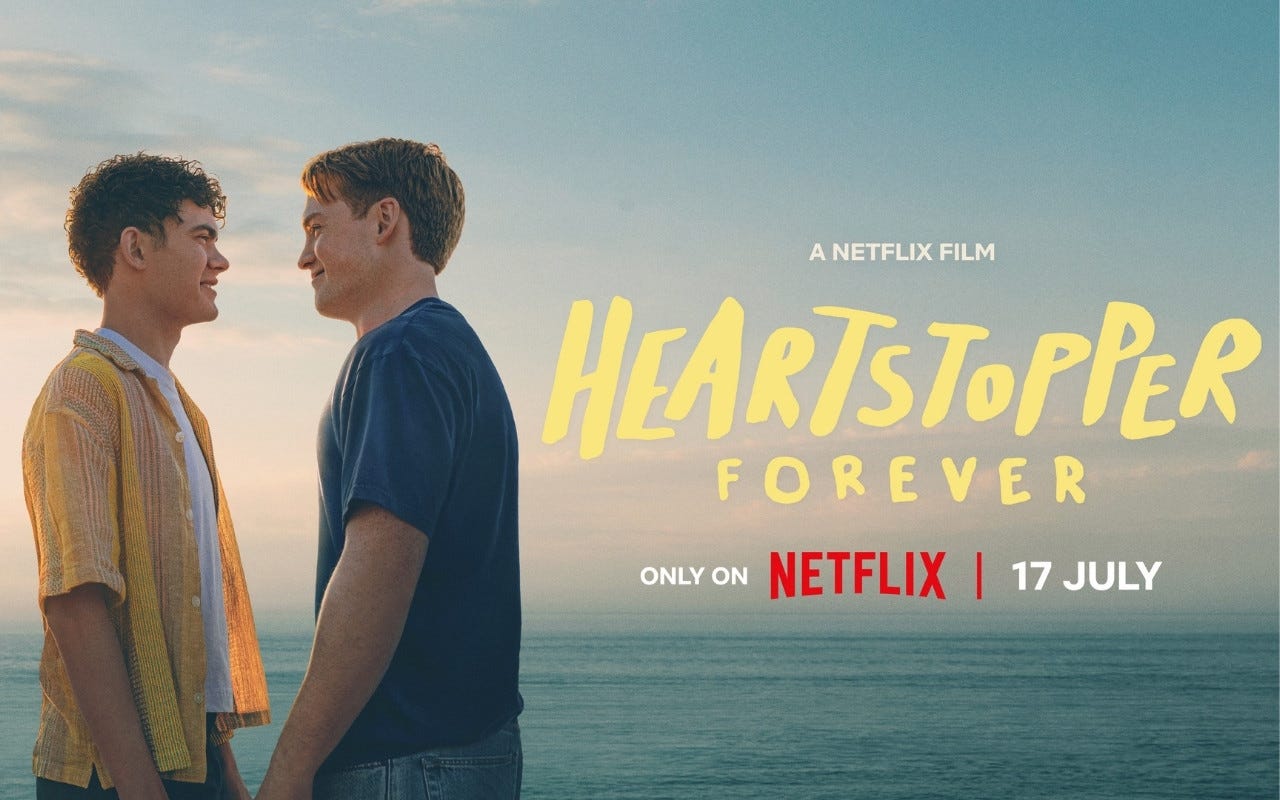
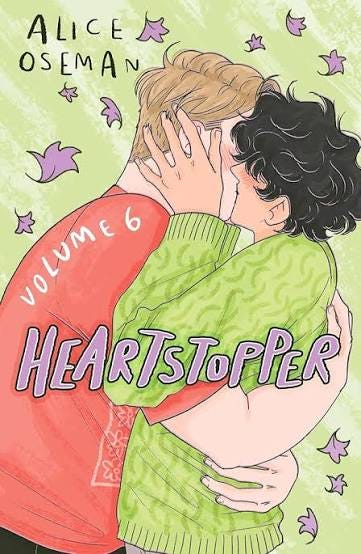
I spent Thursday and Friday reading the last Heartstopper and Saturday watching the film, so I feel suitably immersed in the world to comment (yes, I could have read the novel in the two weeks I’ve had it, what of it…).
Obviously, fair warning for spoilers to both.
Let’s get one thing clear first: yes, it would have been better as a series, and yes, there was much left out/unresolved because of that. But given the circumstances, and the powers that be seemingly even wanting to axe the most successful gay show (outside of those hockey guys) in recent years…ours is not to reason why. But yes, there was a feeling of missing out in the film form. But that doesn’t mean it wasn’t a fitting end to Nick and Charlie’s chapter.
On the book too, you can’t help but wonder, as is so often the case, what the story would have been had there not been the huge global interest and impact of the TV show (which I think can be felt in Oseman’s writing in the last two books). I think back to my beloved Check, Please! Which began life around the same time, in the same way, and got the privilege of only niche-fan attention, so played out exactly as its author intended, without outside influence. I don’t blame Oseman (whose writing I adore outside of Heartstopper) for letting some of the outside seep in, but the novel did leave me wondering about what it might have been.
But as with the film, that doesn’t mean it wasn’t a good ending to Nick and Charlie’s story. But of course there’s more to say on that.
In terms of the story then, and the way Oseman handled wrapping up several years of teen drama in a single book/movie, I’d say almost all of it felt like the ‘right’ ending- and story- for those characters.
The happy ending is a given. Heartstopper is a romance series, and while we can’t strictly call it a romcom as it’s fairly light on the ‘com’ (not that it isn’t funny, I just have very particular standards on what can be a ‘romcom’), either way the ‘happy ever after’ is a guarantee of the genre…and that’s not a bad thing.
Is it realistic that Nick and Charlie defy the oft-repeated ‘teen relationships never last’ stereotype? No, but in defying that, they’re fulfilling the expectations of their genre. We can make the same argument for any romcom: do Tom and Meg make it at the end of Sleepless in Seattle? Does Vivian stay with Edward in Pretty Woman? Hell, do Bella and Edward make it? Do Troy and Gabrielle? We’re not supposed to think of the what-ifs; we’re supposed to relish in the happy ending.
Given that it’s a queer happy ending, we should relish in that. We should relish in the teen queer happy ending. Because that was always the point of Heartstopper. It wasn’t the look at the serious issues of teen life (though they are well handled and important). It was happy queer teens finding friends, finding support and going off into the world to be themselves.
And on that, Heartstopper delivered. Yes, Charlie and Nick’s happy ending is important, but more so is theirs and the whole gang’s being delivered into adulthood as healthy, mostly happy, and secure in who they are.
That was my happy ending.
In that we get Elle, terrified as a young trans woman, as of course she would be, but out there doing it anyway. We get Imogen finding out who she really is (and she was always a secret favourite of mine, rooting for her to figure it out). We’ve got Tori (more on her in a bit) secure in her asexuality and her relationship, Issac (cough Aled) the same, and both of them finding each other as friends. We’ve got Tao, the ultimate ally to his friends, out there as a brilliantly queer-educated straight man, making the world a little easier for the new queer folks he meets. Darcy finding their nonbinary identity and Tara growing into her lesbian identity, and supporting her partner in their discovery. That Heartstopper sends all of them out into the world, sure of themselves (as sure as you can be at 18) and knowing they were supported to get there…including, yes, Nick and Charlie.
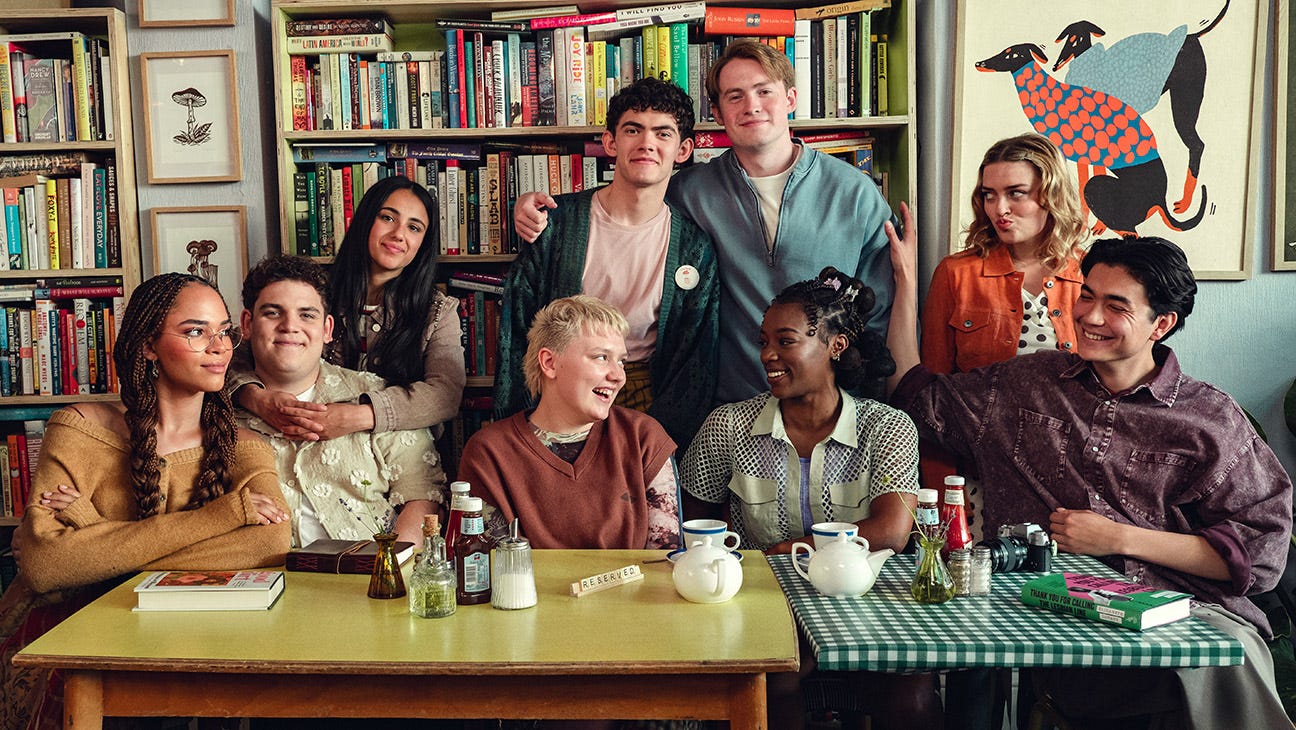
Because while Charlie was always sure of his gay identity, the story delivers him more certain of himself-and how to handle his mental health. With it too, Nick, sure of who he is at last by the end, and yes ‘I’m bi actually’ but also knowing who he is outside of rugby and his boyfriend.
And look, Heartstopper is a fantasy in that way too, but maybe that’s also the point. It’s a lead-by-example approach across all age ranges. Because even the bullying is gentle in Heartstopper world, a bit of teasing and stealing a pencil case, and maybe that’s ok too; we don’t always need gritty reality; we sometimes need a ‘this is how it could be’ because, actually, imagine a world where a stern word from the gay head boy was enough to send the bullies scarpering.
And ok, my Comprehensive School of the 90s raised self can never quite get on board with the twee blazer-wearing Boys Grammar School of it all…where are the lads having a fag around the back (yes I said fag, the British kind), where are the penises carved into the desks? Why isn’t every building falling down? That’s a British school experience.
That said, the film did give us a handjob on a pier, and honestly that’s the most realistic Heartstopper has ever been.
But also, as the series has gone on (and the novels), Heartstopper has managed to walk a good line of ‘issues’ and idealised fantasy, and both are equally as important. And it’s important that it addresses those issues (for want of a better way to put it) within the world it created. So no, when Charlie gets ill, the show doesn’t become a hard-hitting drama on eating disorders and self-harm, but what it does do is address those issues while staying true to its tone and format.
And while I can’t speak to- and neither does the show try to speak for- everyone who has encountered those issues, as a teenager who lived with an eating disorder (or continues to, as none of us is ever free from it), I felt the story showed the reality of that well- particularly in the film. The previous series maybe glossed over things more than it needed to, but actually in Charlie’s potential relapse, his ongoing struggles with mental health, and to stay free from self-harm…that felt like one of the most honest and yes ‘real’ moments in the show. Props too to Joe Locke, because his panic attack and struggle not to self-harm was painfully real. And while it might go unnoticed by many, just the look in his eyes when he’s struggling, showing that outright fear of food, was incredibly well played but also sensitively balanced.
Because we have to remember that while most of Heartstopper’s audience have aged into adulthood now (or were adults when the show started), this is still a show targeted at teenagers, and so the way it addresses these issues- and yes, the way it addresses sex- needs to be age-appropriate for that younger audience. And while there has been endless debate about teen-gay-sex as there always is, again this felt pitched right. We got the right amount of teen hornienss without being graphic- which feels like the right balance for the show’s tone, and making it more universally age-appropriate (by which I mean any sex being portrayed in an age-appropriate way, this doesn’t it might surprise some online critics, need to be Heated Rivalry when it’s a teen show).
The final instalment showed that their relationship with sex had matured, as had their own character development. It’s a valid point of critique that in the move to the movie/end book we lost the character development of everyone else, but Nick and Charlie’s story- which rightly had to be put front and centre- did show their development. The biggest frustration with their characters in previous instalments is both how static they are and how defined only by their relationship they are. Having the movie address that head on, having Charlie be already so much more sure of himself, having created an identity outside of ‘bullied gay kid’ and ‘Nick’s boyfriend’ passes the challenge to Nick to do the same. And the story manages to do that, without deviating too much into a family soap or dark night of the soul coming-of-age. And while retaining all his Golden Retriever walking-green-flag-boyfriend characteristics. It balances the romance novel of it all with some genuine character development for our leads, and what more really do we need?
Heartstopper does give us more, however, and while yes, the stories of the friendship group are limited by time, there’s enough to make an impact.
For me, as an asexual person, and partly the reason I love Oseman’s writing is that even in this story that centres a more traditional cis-male relationship, there’s space made for asexual stories. Issac got his arc last season, so I wasn’t too sad to see him sidelined a little this time (I was bitter that Aled in the novels got only one scene). But to see Issac living his best life, embraced by his friends and allowed to be his brilliant weird self… the thing is, Issac always knew who he was, and it was a joy to see him just continue to be that. Seeing him finally share a moment with Tori warmed my little Ace heart too.
Because Tori Spring, the icon that you are, gave us, I think, what Oseman really wants us to take away from Heartstopper: that however and whoever you love is your business. That it doesn’t have to fit into a cookie-cutter, and it just has to feel right for you. And yes, my knife-shoe-loving heart loves that speed skating is now part of her world.
Tori was important to me, because, unlike some folks my age, I’m not able to project the ‘what ifs’ of my teenage crushes onto Nick and Charlie and imagine that world for me…which is the main appeal for older queers, I think. Because I didn’t have them. Because I didn’t have a language for who I was and how I love. Tori Spring gave me that, and the final instalment of Heartstopper might have given people the teen romance they dreamed of, but it gave me the validation that, like Tori, like Isaac, it never mattered if I didn’t love (or lust) like the other teens; I was always just as valid.
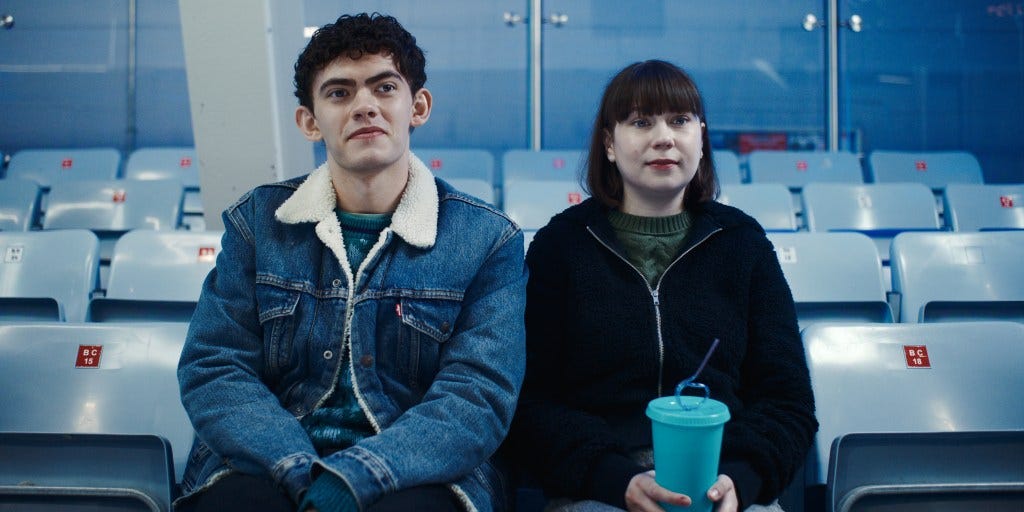
The meaning of Heartstopper has always been the ‘what if’ for the gay (and bi, actually) teens who didn’t have it. But giving us Ace folks our part in the story too meant a lot.
So ultimately, it isn’t Nick and Charlie’s happy ending- wonderful as it is- that gets me; it’s Tori and Issac and the being seen. But more than that, in both the novel and the show, it was Tao who broke me both times.
Not just because his sentiment is so perfect- the idea that whether you see these people again, they’ve shaped your life forever and will still be a part of it. But also because Tao is the underrated friend, he’s been there cheering everyone on- and sure he missteps at tiems because he’s a teenager too- but Tao supported his best friend through her transition, when he fell in love with her he put her first, he’s always there for Issac even when everyone else is tied up in their messy relationships, and he’s always there cheering everyone on. I don’t want to position him as an ‘ally-saviour’ role because that’s messy, but actually having the straight boy ally so visibly be an ally- that’s as important a role model as the queer characters too- showing there is another way. Shoutout to William Gao for making him so real, so authentic, and for making me cry.
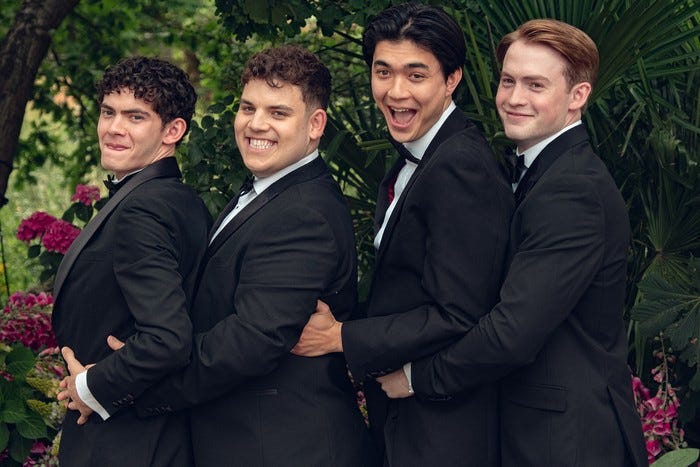
The thing about Heartstopper too, is that it’s a fantasy, and it’s a very personal fantasy. It’s the ‘what high school could have been’ for all of us whether that was two years ago, or [redacted] years ago. But that’s also really personal to who we are, what particular branch of the queer tree we fell out of, and what we wished for at the time. For some people it’s their Nick or Charlie, for others it’s the queer family, the ability to be who they were, or just knowing who they were. So the final instalment could never be perfect-on-paper, but actually it was never about what was on paper (or screen) it was just…the idea of that high school happy ending.

And while the expected happy ending for Nick and Charlie is so important for that, so are the happy endings for everyone- or at least the possibility of them. Because that’s what Heartstopper was really about: the possibility of queer love, queer joy.
Shout out as well to the wonderful staff member at Griffin Books, who, when I was getting my Heartstopper book signed, made sure Alice Oseman knew I’d written a book too (and to my friend Andrew for enthusiastically waving it at her). More importantly, thank you, Griffin Books, for giving me a chance to say thank you to Alice for the Asexual stories she’s (so far) given us. Nick and Charlie might be the thing that got the world’s attention, but giving us those stories meant so much to those of us without ours.